
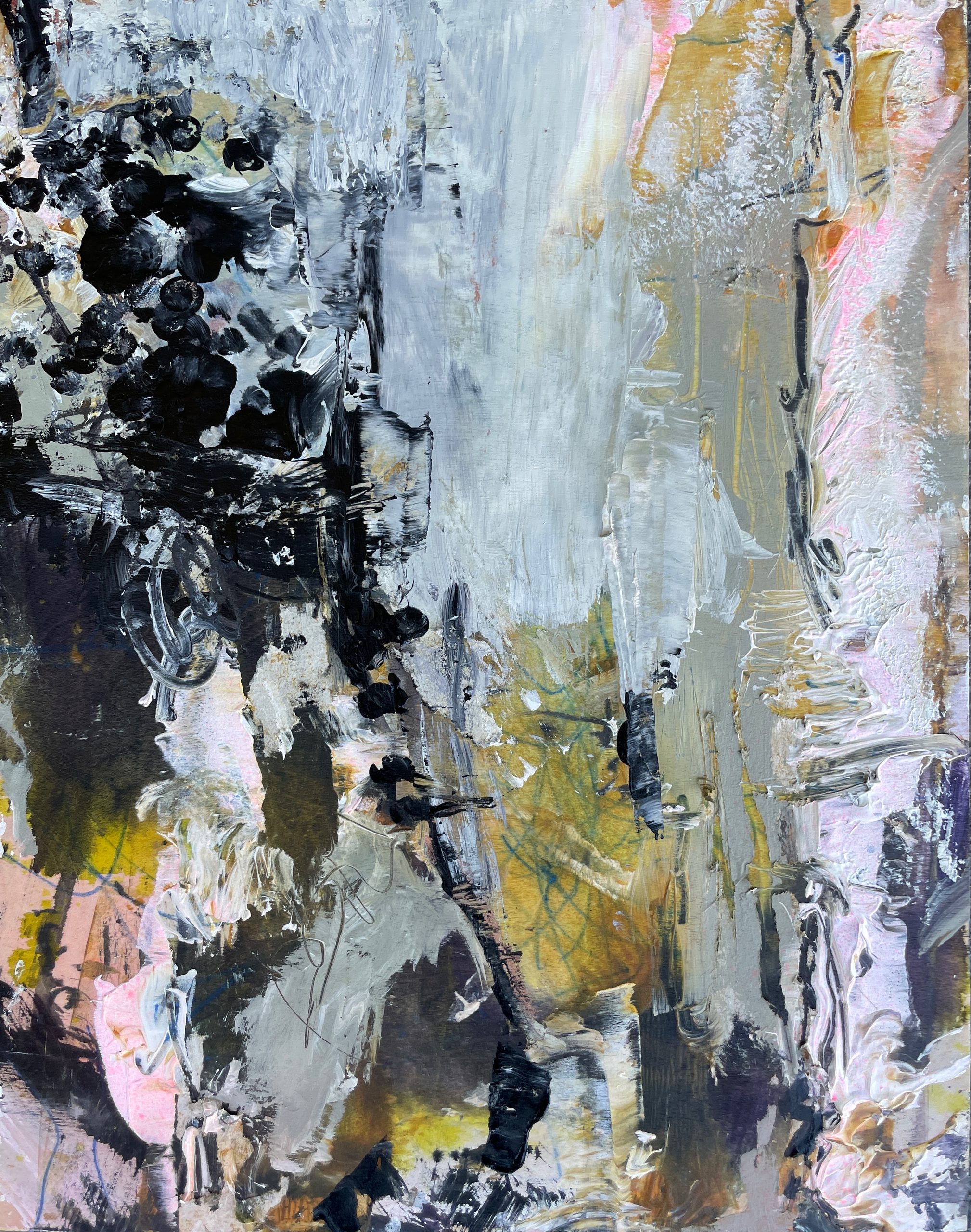
Why I love painting on wood panels—and why you might want to give them a try.
Have you ever been working on an abstract painting, reached for your scraper to remove a layer of paint, and hesitated because you were afraid of damaging the canvas?
Or maybe you’ve created a painting you love, but the surface has become so textured and uneven from all your experimenting that you’re not quite happy with how it looks.
I’ve been there.
After nearly 30 years of painting, I’ve worked on all kinds of surfaces. And while I still use canvas, there’s one surface I’ve come to appreciate more and more in my studio.
Wood panels.
They’re sturdy, smooth, versatile, and surprisingly affordable. And for the way I paint—building layers, scraping back, adding marks, removing marks, and sometimes getting pretty aggressive with my tools—they offer some real advantages.
But recently, I had another reason to appreciate them.
Three of my paintings sold in one week at the gallery. And all three were painted on wood panels.
Coincidence? Maybe.
But it got me thinking about why I’ve become such a fan of painting on wood, and why I think more abstract painters should consider giving it a try.
Let me explain.
Three Paintings Sold in One Week—and They Were All on Wood
I show my work at a gallery located on the ground floor of a high-end hotel in Albuquerque, New Mexico.
It’s an interesting setting because many of the people who visit the gallery are travelers. They’re here enjoying the region, exploring the art scene, and perhaps looking for something special to bring home.
Recently, three of my paintings sold in the same week.
Of course, I’d like to think the collectors bought them because they connected with the artwork. That’s always what I hope for—that something about the color, composition, or feeling of a painting resonates with someone enough that they want to live with it.
But two of those paintings were small wood panels, and I couldn’t help noticing something else.
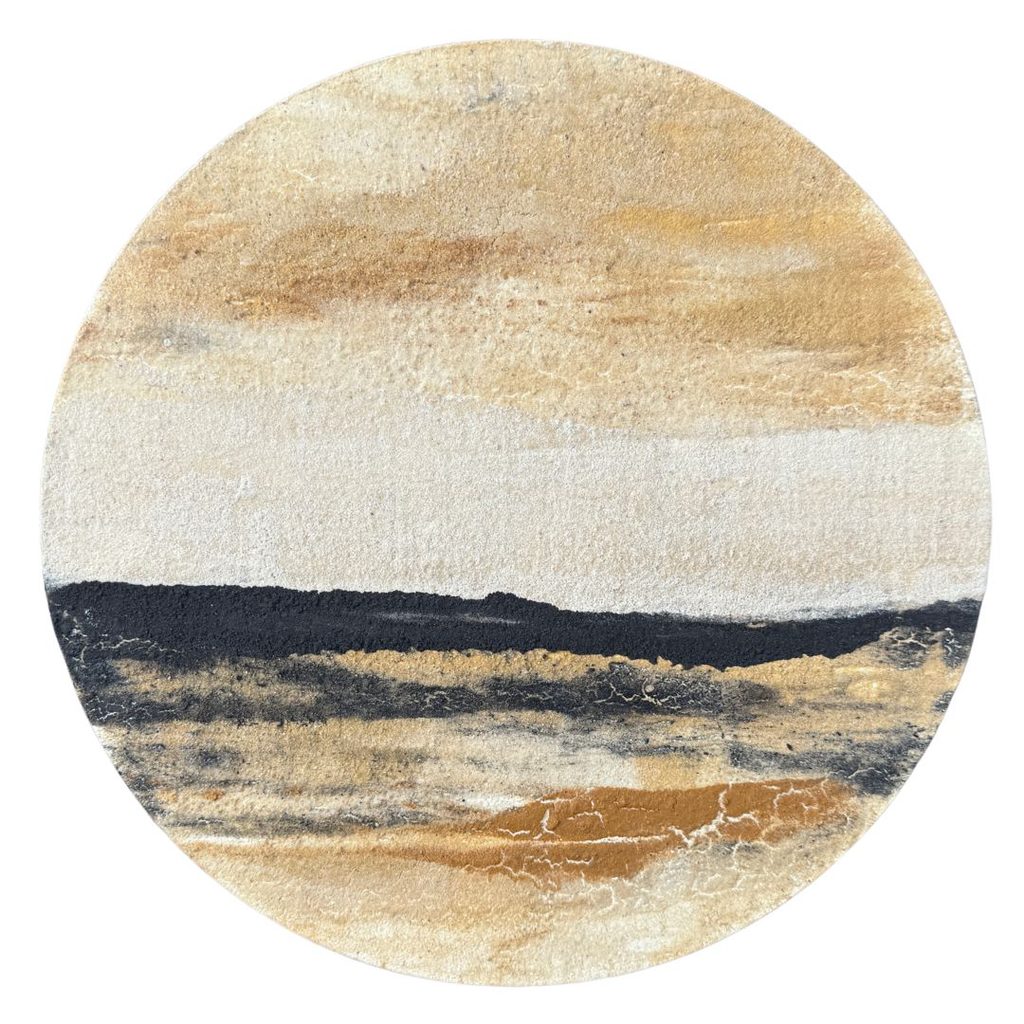
They would have been incredibly easy to take home.
A small painting on wood panel can be carefully wrapped in protective material, tucked into a suitcase, and transported without the bulk of a stretched canvas. Of course, you’d still want to protect the corners and painted surface, but a small panel is a pretty convenient format for someone traveling.
I don’t know whether that influenced the purchases.
But when your gallery is located in a hotel where people are constantly flying in and out, portability certainly doesn’t hurt.
And this brings up something artists don’t always think about when choosing their materials.
The surface you paint on affects more than the painting process. It also affects how your artwork is displayed, handled, stored, transported, and ultimately enjoyed by a collector.
For artists who are beginning to sell their work—or hope to someday—those practical considerations are worth thinking about.
But honestly, that’s not the main reason I love wood panels.
The real reason has everything to do with what happens in my studio.
1. Wood Panels Can Take a Beating (And That’s a Good Thing)
If you’ve watched me paint, you know I’m not particularly gentle with my surfaces.
I scrape. I scratch. I push paint around. I remove layers. Sometimes I use quite a bit of pressure with my tools.
It’s all part of how I build an abstract painting.
And this is where wood panels really shine.
Unlike stretched canvas, which has some give when you push against it, wood provides a firm, rigid surface.
You can press down with a scraper without worrying about the surface flexing underneath your tool. You can scratch into layers of acrylic paint, remove sections, and expose what’s underneath. You can make bold, aggressive marks without constantly worrying that you’re going to damage the support.
Try pushing too hard with a sharp tool on stretched canvas, and you could end up with a dent, a tear, or even a hole.
Not exactly the creative breakthrough you were hoping for.
A properly prepared wood panel is much more forgiving of this kind of physical manipulation.
Now, I’m not suggesting it’s indestructible. You can certainly gouge wood if you use enough force or a sharp enough tool.
But for my painting process, it gives me much more freedom.
And freedom matters.
Why this changes the way you paint
Here’s something I’ve noticed after teaching abstract painting for more than 20 years.
Many artists are afraid to make bold changes to a painting once they’ve invested time in it.
They’ll say things like:
“I liked it… then I did something to it.”
Or they’ll hesitate because they’re worried that one more mark will ruin everything.
I understand that feeling. Even after decades of painting, I still have moments when I’m not sure what to do next.
But one of the most important things you can learn as an abstract painter is that subtraction is just as valuable as addition.
Sometimes the best decision isn’t adding another color or another mark.
It’s removing something.
Scraping back a section can reveal an earlier layer, create an interesting edge, or introduce a contrast that the painting was missing.
When I’m working on wood, I can make those decisions more freely because I trust the surface to hold up.
That doesn’t mean every decision will be a good one!
But it does mean I can experiment without worrying quite so much about damaging the painting itself.
And that opens up possibilities.
2. I Love the Smooth Surface of Wood
This might actually be my favorite thing about painting on wood panels.
The smoothness.
There’s something beautiful about applying acrylic paint to a smooth, rigid surface. The paint glides across it differently than it does on canvas.
You don’t have the woven texture of the canvas showing through your brushstrokes, and you can create wonderfully clean, uninterrupted areas of color.
I especially love this when I’m making paintings that don’t have a lot of physical texture. Sometimes I want the interest in a painting to come from the relationships between colors, shapes, values, and marks—not from thick paint or heavy texture. A smooth wood panel allows those relationships to take center stage.
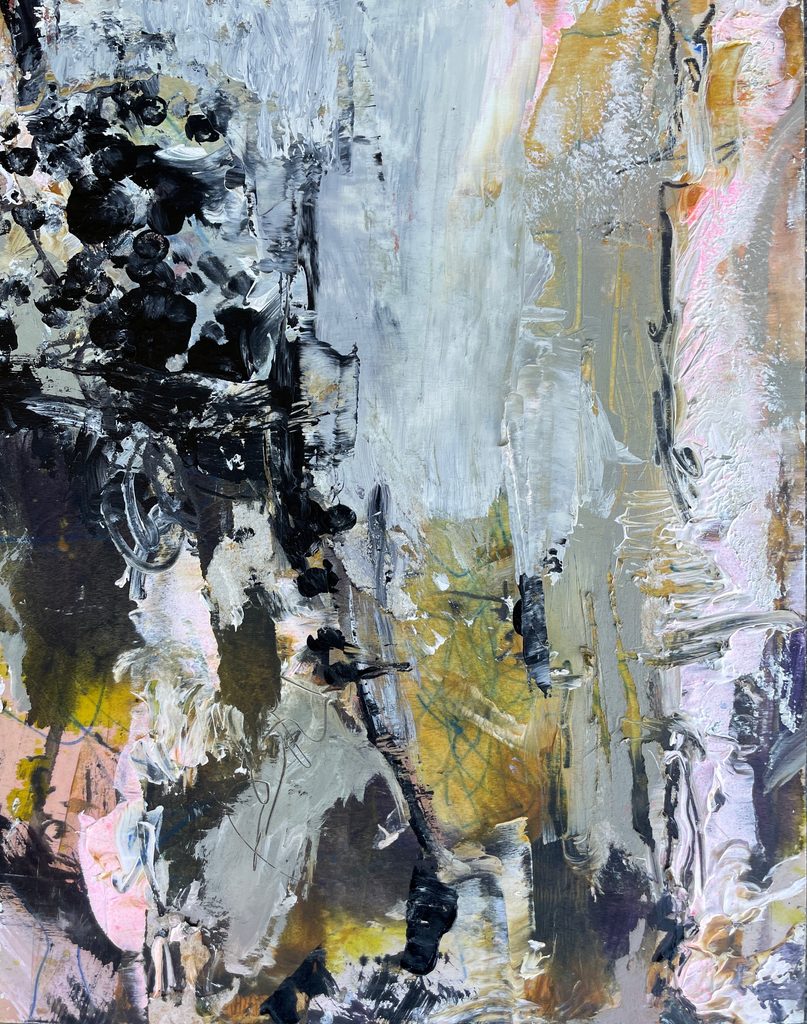
And even when I do build up texture in certain areas, I love the contrast between those textured passages and the smooth sections that remain.
Think about what happens when you have a rough, scraped area next to a beautifully smooth field of color.
Each makes the other more interesting.
The rough area feels rougher.
The smooth area feels calmer.
That’s a design principle at work: contrast creates visual interest.
And contrast doesn’t just mean light against dark or warm against cool.
It can also mean rough against smooth, busy against quiet, or complex against simple.
When you start thinking about your surface in those terms, you’re no longer just choosing something to paint on.
You’re making an intentional design decision.
3. You Can Let the Natural Wood Show Through
Another wonderful thing about wood panels is that you don’t necessarily have to cover up the wood.
I love the warmth of natural wood, and sometimes I want that warmth to become part of the painting.
This is where clear gesso comes in.
Instead of priming the panel with white gesso, you can use clear gesso to prepare the surface while allowing the natural color and grain of the wood to remain visible.
The result can be beautiful.
That warm wood tone becomes another element in your composition.
You might leave sections exposed, build transparent layers over them, or allow the wood to peek through between painted shapes.
It can create a lovely sense of warmth and unity throughout the painting.
And because you’re starting with a warm, neutral surface rather than bright white, your color decisions may feel different from the very beginning.
For example, a transparent blue over warm wood will look different from that same blue over white.
That’s because the color underneath influences what we see.
Understanding how colors interact is one of the foundational principles I teach in my abstract painting classes, and working over a natural wood surface gives you another way to explore those relationships.
One important note: choose a clear acrylic ground that’s compatible with your painting medium and follow the manufacturer’s preparation instructions. Clear gesso provides a painting surface, but it isn’t necessarily a complete moisture barrier or stain-blocking sealer for raw wood.
My recommended clear gesso: Shop clear gesso here
Prefer a white surface? No problem.
If you love starting with white, you can absolutely use white gesso on your wood panel.
You’ll get a bright surface similar in color to a primed canvas, but with the added benefit of that firm, smooth support underneath.
Keep in mind that gesso has some tooth, so if you want an especially smooth finish, you may want to apply several thin coats and lightly sand between them once they’re dry.
Personally, I love having both options.
Sometimes the warmth of the wood is exactly what I want.
Other times, I want a clean white starting point so my colors appear bright and fresh.
The important thing is choosing intentionally rather than automatically reaching for the same surface every time.
4. Wood Panels Are Surprisingly Practical
Let’s talk about a few practical advantages.
Because while I love experimenting in the studio, I also appreciate materials that make my life easier.
They’re lightweight
Small and medium-sized wood panels can be quite lightweight, especially compared with heavier, more elaborate painting supports.
That makes them convenient to move around the studio, transport to workshops, store, and deliver to galleries.
Weight will depend on the size, thickness, and construction of the panel, of course.
They’re affordable
You don’t necessarily have to spend a fortune to experiment with wood panels.
There are beautiful professional-quality panels available, but there are also economical options that are perfect for studies, experimenting, and developing new ideas.
I always encourage my students to invest in good materials where quality matters, but I also don’t believe you need the most expensive supplies to make compelling artwork.
A well-prepared, affordable wood panel can be a wonderful place to explore.
They come in different shapes and sizes
Another thing I love is the variety.
You can find traditional rectangular and square panels, but also round panels and other interesting shapes.
Changing the shape of your painting surface can challenge you to think differently about composition.
A square composition behaves differently from a long horizontal rectangle.
And a circle? That’s a whole different design problem.
Sometimes simply changing the format helps you break out of familiar habits.
If you’ve been making the same size and shape of painting for years, trying something different can be a fun way to stretch your creativity.
5. My Favorite Wood Panels for Abstract Painting
There are lots of wood panels available, but here are two options I’d recommend exploring.
Best quality: Ampersand wood panels
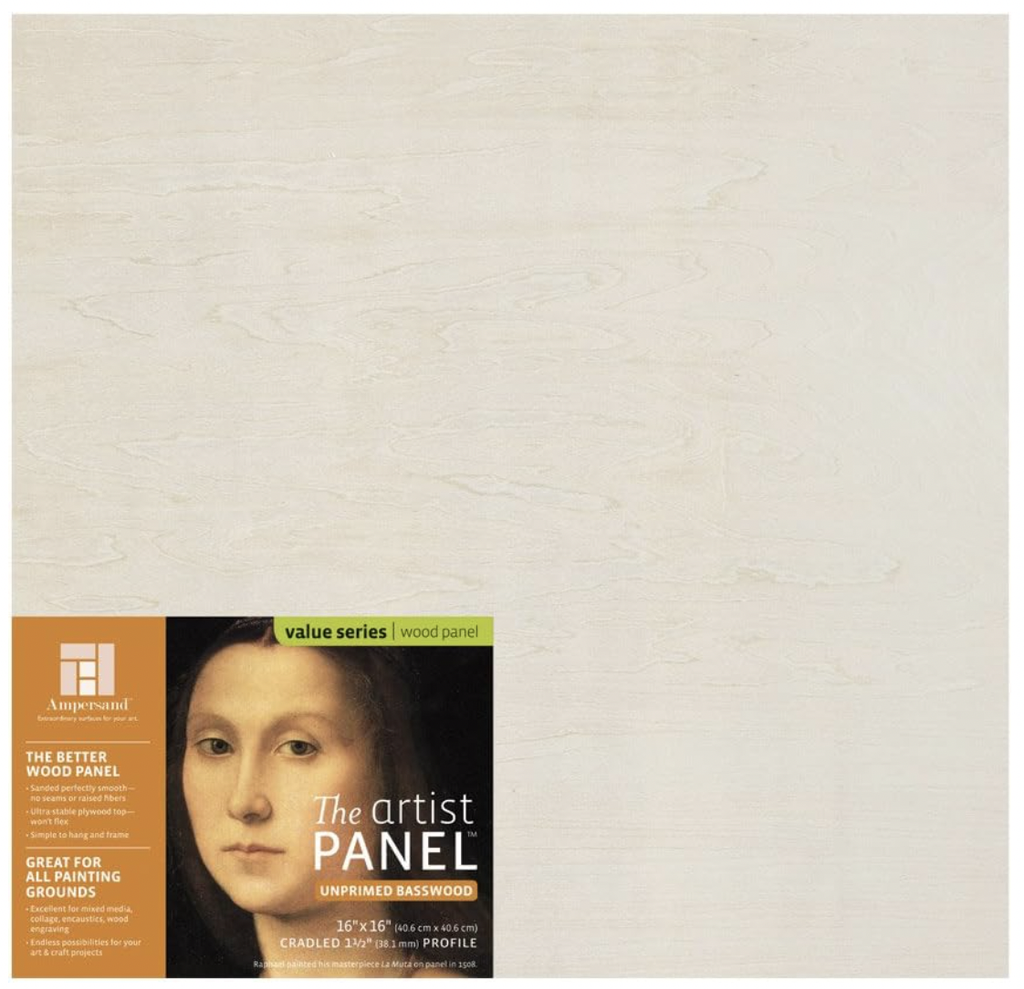
Ampersand is known for making high-quality artist panels, and it’s a brand worth considering if you’re creating finished artwork for exhibition or sale.
They offer different surfaces, including smooth, prepared painting grounds and wood panels intended for artists who want to prepare their own surfaces.
Be sure to check which type you’re purchasing, because not every Ampersand panel has the same surface or requires the same preparation.
If you’re investing significant time in a painting you hope to exhibit or sell, choosing a well-constructed, archival-quality support is a smart decision.
Best value: Affordable wood panels
My best-value wood panel option—shop here
If you’re new to painting on wood, you don’t need to start with the most expensive panels.
An economical option is a great way to experiment and see whether you enjoy the feel of a rigid surface.
I especially recommend trying several small panels, and I use these in my painting retreats so students can easily bring their work back home.
Use them to test your scraping tools, explore different grounds, experiment with transparent layers, or practice building and removing paint.
Just pay attention to the quality of the wood, the construction, and whether the panel needs additional preparation. I like to gesso the surface first.
And if you’re planning to sell or exhibit a painting, make sure the materials and preparation are appropriate for long-term durability.
Note: The product links above are affiliate links, which means I may earn a small commission if you purchase through them, at no additional cost to you.
6. How I Recommend Getting Started With Wood Panels
If you’ve always painted on canvas, I don’t think you need to replace every surface in your studio tomorrow.
Instead, try a little experiment.
Get two or three small wood panels and approach them with curiosity.
Here’s what I’d suggest:
First, prepare your surface. Try white gesso on one panel and an appropriate clear ground on another. Notice how the starting surface affects your color choices and the overall feeling of the painting.
Next, build some layers. Apply acrylic paint, let it dry, and add more layers. Don’t worry about creating a finished painting right away.
Then, start removing paint. Use a scraper or another suitable tool to gently work back through some of the layers. Notice the edges, marks, and unexpected color combinations that emerge.
Finally, compare the results. What feels different from painting on canvas? Do you like the smoothness? The resistance? The way your tools respond?
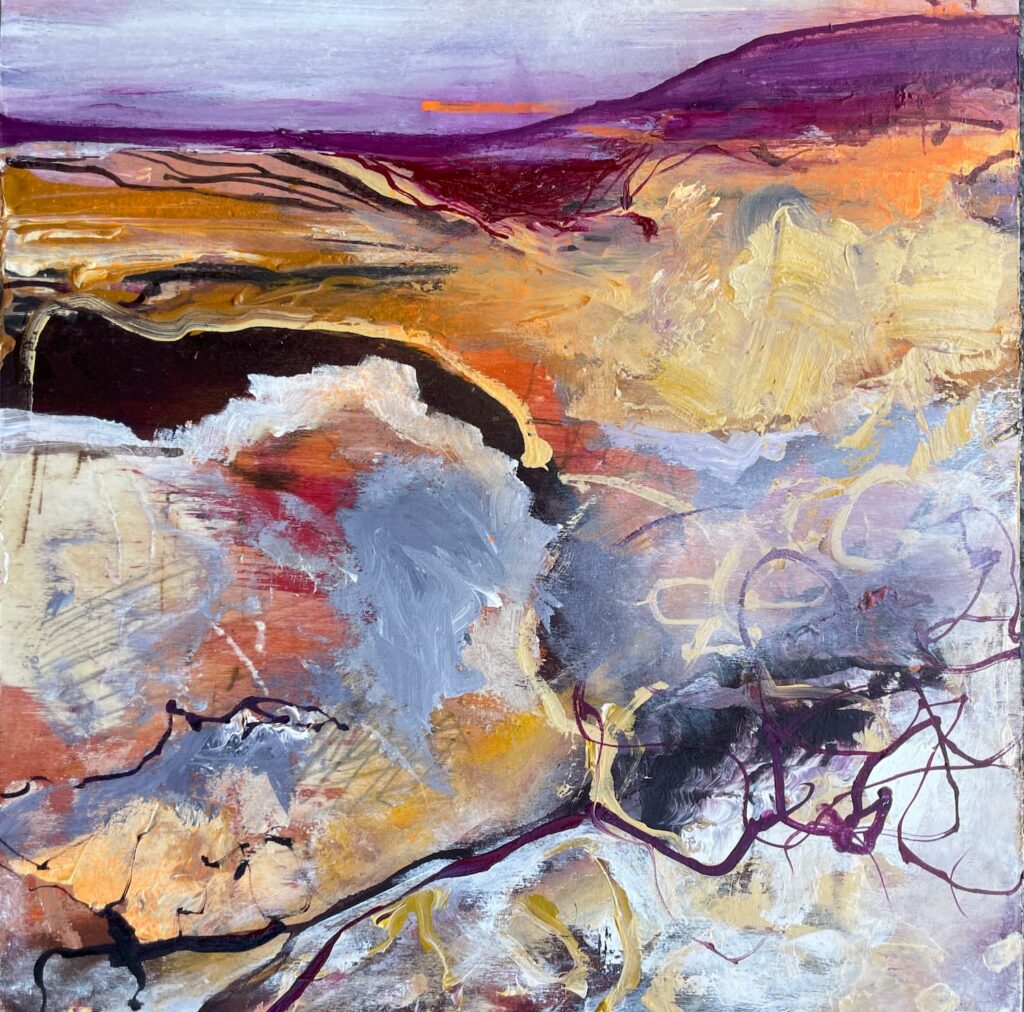
Pay attention to how the surface affects your decisions.
Because that’s really the point of this exercise.
Not just to learn another technique, but to understand what different materials make possible.
And once you understand those possibilities, you can choose the right surface for the kind of painting you want to create.
7. Does This Mean I’m Giving Up Canvas?
Absolutely not.
I still love canvas, and there are plenty of reasons to use it.
Canvas has a wonderful texture of its own. It’s available in large sizes, and its flexibility and relatively light weight can be advantages for certain kinds of work.
For some paintings, canvas is exactly the right choice.
But for others, especially when I know I’ll be doing a lot of scraping, scratching, layering, and removing paint, wood panel is often my preference.
The important thing is understanding the difference.
After nearly 30 years in the studio, I’ve learned that there isn’t one perfect material for every artist or every painting.
There are simply materials that support different ways of working.
And the better you understand them, the more intentional your choices become.
The Bigger Lesson: Your Materials Should Support Your Creative Process
When I think back to those three paintings that sold in one week, I’m delighted that they found new homes.
And yes, I find it interesting that all three were on wood panels.
But I wouldn’t go so far as to say that painting on wood will make your artwork sell.
Collectors respond to the artwork itself—the color, composition, energy, and emotional connection they feel.
A beautiful surface can’t compensate for a composition that isn’t working.
And expensive materials won’t automatically make a painting more compelling.
What good materials can do is help you work more freely and confidently.
For me, wood panels allow me to explore my paintings in ways that feel natural to my process.
I can build layers, scrape them away, create smooth passages, introduce rough marks, and keep working through that sometimes frustrating messy middle.
And believe me, even after all these years, I still have paintings that make me wonder what on earth I’m doing.
The difference is that I’ve learned how to evaluate what’s happening and make more intentional decisions about what comes next.
That’s what I want for you, too.
Not just a collection of techniques or supplies, but the understanding that helps you create paintings you feel genuinely proud of.
So if you’ve never tried painting on wood, give it a chance.
You might discover that you love the smoothness, the durability, or the freedom to scrape and experiment.
Or you might decide canvas is still your favorite.
Either way, you’ll have learned something valuable about your own painting process.
And that’s always time well spent.
I’d Love to Hear From You
Do you paint on wood panels, canvas, or both?
Have you noticed a difference in how you work on each surface?
Tell me in the comments. I’d love to know which surface you prefer and why.
Ready to Create Abstract Paintings with More Confidence?
Love abstract art but struggle to make your own paintings come together? Join me for my FREE training, The 5 Missing Pieces Between You and Painting Abstracts with Confidence. I’ll share practical strategies to help you create stronger compositions, make more confident creative decisions, and develop paintings that feel uniquely yours.
About Andrea Cermanski
Andrea Cermanski is a Santa Fe-based abstract painter, gallery-represented artist, and founder of Santa Fe Painting Workshops. With nearly 30 years of painting experience and more than 20 years of teaching, she helps artists understand the foundational principles of composition, color, and design so they can create compelling abstract paintings with greater confidence.
Andrea holds a bachelor’s degree in Art History and a master’s degree in Art Education. Her work has been exhibited in galleries around the country, and she teaches artists through online courses and in-person painting workshops in Santa Fe, New Mexico.
Leave a Reply
Subscribe to get painting tips and news about my latest artwork & upcoming events.
Follow me@santafepaintingworkshops


