
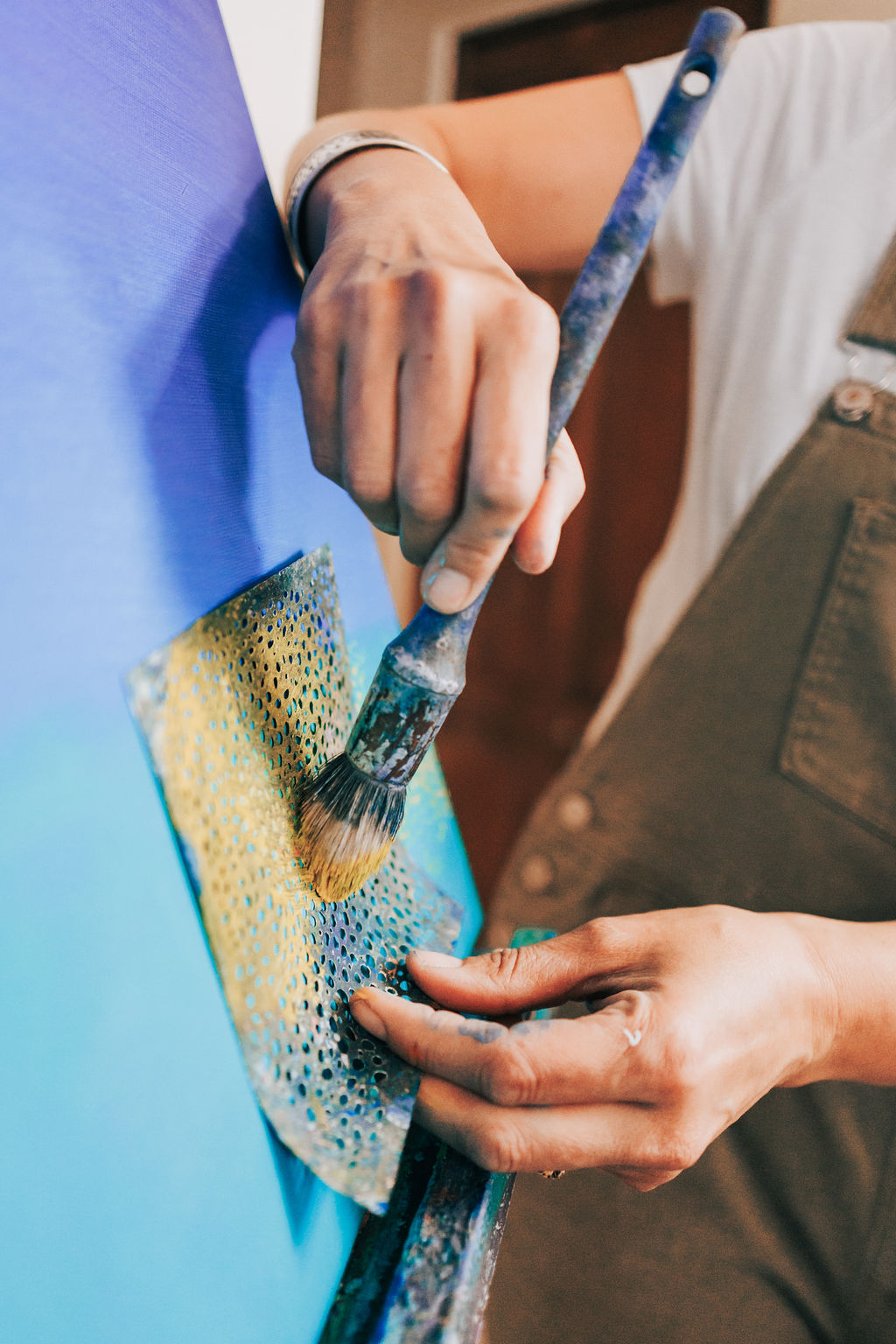
Does this sound familiar?
You set up your supplies. The canvas is ready. The colors are mixed. But then… you freeze.
That blank canvas stares at you for days, maybe weeks. You keep thinking, What if I mess it up? What if I ruin it? What if it’s not good enough?
If you’ve ever felt this way, you’re not alone.
Many creatives struggle with perfectionism, and it can prevent us from ever truly getting started.
As an abstract artist and teacher, I’ve watched hundreds of students wrestle with that fear of making the “wrong” mark. And I’ve wrestled with it myself, even after decades of practice.
The good news is, perfectionism isn’t something you’re stuck with forever. And abstract painting is one of the best tools I know to help you move through it.
Today, I want to show you how perfectionism shows up in abstract painting, why it holds you back, and how you can embrace imperfection to find real creative freedom.
Why Perfectionism is So Common in Artists
First of all, if you’re a perfectionist — even just a little — it makes sense.
Many of us grew up in environments where we were praised for getting things right. Maybe you learned to avoid mistakes because they led to criticism, or you equated being perfect with being “good enough.”
And in art, that feeling can be even more intense. Because what we create feels personal. Vulnerable. We want our work to say something about who we are, and we want that something to be impressive.
That’s why so many artists let their canvases sit blank, afraid to ruin them.
But here’s the thing:
In abstract painting, there is no right or wrong mark.
Every brushstroke you put down is a choice, and every choice leads you somewhere new. Sometimes those choices don’t turn out the way you planned, but often, those “mistakes” become the most interesting and memorable parts of your painting.
What Perfectionism Looks Like in Abstract Painting
Over the years, I’ve seen perfectionism show up in abstract painting in a few common ways:
- The blank canvas trap: You don’t even start because you’re waiting for the “right” idea.
- The overthinking loop: You spend hours planning colors, composition, and techniques, but never actually paint.
- The safe zone: You stick to the same colors, shapes, and patterns because you’re afraid to experiment.
- The constant editing: You keep painting over your work, trying to “fix” it, but never actually finishing a piece.
If any of these sound familiar, you’re in good company. I’ve been there too.
Why Perfectionism Holds You Back
Perfectionism can feel like it’s helping you aim higher. But in reality, it’s keeping you stuck.
When you’re afraid to make the “wrong” mark, you miss out on discovery. You miss the joy of experimentation. And you miss the chance to learn from what doesn’t work.
One of the most freeing lessons abstract painting teaches is that imperfection is often more beautiful than control.
I’ve had countless paintings where the boldest, most interesting sections came from accidents. From letting my hand slip, from dropping water where I didn’t mean to, or from overworking an area to the point it cracked and revealed something unexpected.
Those are the marks people notice. The ones they lean in to see up close.
So what if imperfection wasn’t just okay… but actually the goal?
How Abstract Painting Helps Break Perfectionist Thinking
Abstract painting is uniquely suited to help you loosen your grip on perfectionism. Why? Because it’s about expression, not replication.
Here are a few ways abstract painting can help you move through perfectionism and into freedom:
1. There Are No Rules
In abstract painting, there’s no “should.” No one can tell you your color choices are wrong, or your composition doesn’t make sense. This is your space to make whatever marks you feel, without worrying about right and wrong.
Try this: Set a timer for 10 minutes and fill an entire canvas or page with marks, no stopping. Use your non-dominant hand, switch tools halfway through, or close your eyes for part of it. See what happens.
2. Mistakes Become Magic
Some of the most powerful parts of an abstract painting are the unexpected ones. A drip that runs too far. A color that blends in a surprising way.
Instead of covering them up, leave them. Highlight them even. They add character, energy, and authenticity to your work.
Think about Bob Ross’ concept of “happy accidents,” and embrace these moments in your painting process.
3. Strong and Weak Marks Both Matter
Not every mark needs to scream. Some are bold and powerful. Others are soft and quiet. Together, they create rhythm and balance.
When you let go of the idea that every mark has to be perfect, you open yourself up to more variety, which makes your work richer.
4. Imperfection Feels More Human
People are drawn to work that feels alive. Work that shows the hand of the artist. Work that isn’t sterile or overworked.
When you allow imperfection to show through, you invite viewers into your process, and that vulnerability makes your work more relatable.
5. The Act of Painting is the Point
Abstract painting is about the process, not just the finished product. Every time you pick up a brush, you’re learning. You’re practicing. You’re exploring.
When you focus on the act of painting rather than the outcome, you start to see each session as a success, no matter what the canvas looks like when you stop.
Tips to Start Painting Without Fear
If you’re ready to let go of perfectionism and embrace imperfection in your work, here are a few practical steps you can try today:
- Use cheap materials. If you’re afraid of wasting supplies, work on paper or canvas panels instead of expensive stretched canvases.
- Work small. Try a few small pieces instead of one big one. You’ll feel less pressure to make each one perfect.
- Give yourself limits. Use only two colors. Or only one tool. Or only 20 minutes. Constraints can actually free you to just paint.
- Call it practice. Not every painting needs to be a masterpiece. Think of it as a sketch, a study, or just playtime.
- Keep going. If you make a mark you don’t like, keep working. Layer over it. Incorporate it. Let it surprise you.
What If Imperfection Was the Goal?
Here’s something to consider:
What if the whole point of painting was not to create something perfect, but to create something true?
What if each imperfect mark was a way of saying, Here I am. This is how I see the world today.
That shift in thinking can change everything.
I promise you, the more you allow yourself to paint without fear, the more your work will grow. And the more you will grow as an artist.
Final Thoughts
You don’t need permission to paint. Forget the perfect plan or the perfect tools, or the perfect idea.
You just need to start.
One imperfect mark at a time.
If you’re struggling with perfectionism, I invite you to try a simple exercise today: take out a piece of paper and make a single mark. Then another. And another. Keep going for five minutes. No stopping.
When you’re done, step back and really look.
You just created something that didn’t exist before. And that’s enough.
ABOUT ANDREA CERMANSKI
I am an artist out of Santa Fe, New Mexico who has been painting for almost 30 years. I love to teach first-timers as well as experienced painters who need a creative reboot. My work has been displayed in several galleries around the country, and I have a Bachelor’s in Art History, a Master’s in Art Education, and had my work in a show juried by Judy Chicago. The idea of getting more people painting makes me light up as I want to inspire more people to express their creative selves and tap into a place of joy and calm.
WANT TO LEARN MORE?
- Subscribe and get one of the FREEBIES below!
- Ebook on How to Move From Representational Painting to Abstraction: 5 Transformative Art Lessons
- Take the Quiz: What Abstract Artist are you Destined to Be?
- Break Free and Breathe: Type-A Guide to Artistic Play. Powerful exercises to loosen you up to create better abstracts.
- Check out My Online Abstract Painting Course
- Read More Painting Tips Blog Posts
- Check out My Paintings & Art Prints for Sale
- Follow Me On YouTube, Instagram, or Pinterest
Leave a Reply
Subscribe to get painting tips and news about my latest artwork & upcoming events.
Follow me@santafepaintingworkshops


